Zagreb, Croatia: Skip the Coast, This Is Where Your Budget Goes Further (2026 Guide)
Dubrovnik and Split get all the postcards. They also get all the prices that come with international fame, and in peak season both now command rates closer to Southern France than the Balkans. Zagreb gets almost none of that attention, which is exactly why it still feels like a real, working European capital rather than a film set for cruise ship day-trippers.
Here’s what a 2026 trip to Zagreb actually costs, what’s worth your time, and how to add one of Europe’s most photographed national parks to the itinerary for a fraction of what a guided tour charges.

Why Zagreb Deserves Your Time in 2026
Zagreb is a proper European capital with a proper local life: a serious café culture, an art and design scene that punches well above its size, and a compact centre you can walk end to end in under half an hour. Unlike the coast, prices here have stayed grounded, and the city is not building its identity around tourism, it already had one.
Daily Budget Benchmarks for Zagreb in 2026
Based on current 2026 pricing, here is what a realistic day in Zagreb costs:
- Accommodation: hostel dorm beds run €15 to €25 a night; private hostel rooms sit around €60 to €80.
- Food: traditional Croatian fast food runs €7 to €10; a plate of štrukli at a proper local spot is around €8.
- Transport: a 30-minute tram ticket costs around €0.53; the famous 66-metre Uspinjača funicular between the Lower and Upper Town is about €0.66.
- Total daily budget: a comfortable budget traveller should plan on roughly €45 to €60 a day, covering a bed, food, local transport and one activity.
That is meaningfully below what the same categories cost in Dubrovnik or Split, for a city with just as much history and considerably less tourist congestion.
Getting There and Getting Around
Zagreb Airport connects directly to major Western and Central European hubs, and budget carriers regularly run fares well under €60 return when booked ahead. Once you’re in the city, you will barely need transport at all. The centre is that walkable. For the one hill you will want help with, the Uspinjača funicular connecting the Lower Town to the Upper Town is the shortest public funicular in the world, and riding it is as much a novelty as a convenience.
What to See: The Upper Town, for Free
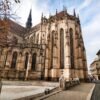
Almost everything worth seeing in Zagreb costs nothing to look at. Ban Jelačić Square is the city’s living room, always in motion, always free. A short climb up leads to Gornji Grad, the Upper Town, where St. Mark’s Church draws every camera for its tiled roof mosaic of the Croatian and Zagreb coats of arms; you don’t need to go inside to get the photo everyone comes for. The Stone Gate nearby is a genuine pilgrimage site tucked into the old city walls, quiet and free at almost any hour.
Down in the Lower Town, Dolac Market has run since the 1930s. The upper outdoor section is stalls of produce, honey and flowers; underneath, an indoor hall of meat and dairy. Nobody will mind if you just wander and look. It is one of the most authentic, least staged things to do in the city, and it costs nothing.
Where to Eat
Štrukli, a baked or boiled pastry filled with cottage cheese, is Zagreb’s defining dish and worth seeking out at a proper local kitchen rather than a tourist-menu restaurant. Ćevapi, grilled minced-meat fingers served with flatbread and onion, is the reliable, satisfying, always-cheap option you’ll find across the city. Dolac Market itself is one of the best places to eat on a budget: fresh produce, local cheese and bread for a fraction of restaurant prices, assembled into the best picnic you’ll have on the trip.
Day Trip: Plitvice Lakes National Park
Roughly 130 kilometres and about two hours south of Zagreb sits Plitvice Lakes National Park, sixteen terraced turquoise lakes connected by waterfalls, and a genuine UNESCO World Heritage Site. Entry price depends entirely on when you go: around €40 in peak summer months, dropping to roughly €23 in the shoulder months of April, May and October, and as low as €10 over winter. A bus from Zagreb runs about €12 each way. Travelling in the shoulder season gets you the same waterfalls, a fraction of the price, and noticeably thinner crowds.

The Same Principle, Different Capital
Zagreb sits in the same category as Sofia, Bulgaria, a fully-functioning European capital that the mainstream travel crowd has simply overlooked while chasing the same six overpriced cities. That is precisely the gap we’re mapping city by city.
Next in the series: Ljubljana, Slovenia, another capital that rarely makes anyone’s shortlist.
👈 Which underrated European capital should we cover next? Drop it in the comments, or DM us on Instagram at @ytrips.eu, we’re building this list with our audience, not just for them.
Cost and pricing data sourced from Budget Your Trip and current 2026 accommodation and attraction pricing. All figures are approximate and vary by season and booking window.