Sofia, Bulgaria: The Most Underrated Capital in Europe for Budget Travelers (2026 Guide)
Ask ten backpackers to name a cheap European capital and you will get the same five answers. Budapest. Prague. Kraków. Lisbon. Sofia rarely comes up, and that is exactly the point. While the rest of Central Europe has spent the last decade getting discovered, priced up and Instagrammed into submission, Sofia has quietly stayed one of the most affordable, most walkable, and most underrated capitals on the continent.
This guide covers exactly what a trip to Sofia costs in 2026, how to get there, what to see, and why the smartest budget travellers are already adding it to their route.

Why Sofia Deserves a Spot on Your 2026 Itinerary
Bulgaria consistently ranks as one of the most affordable countries in the European Union, sitting at or near the bottom of Eurostat’s price level comparisons for both transport and general consumer costs. That means your money moves further here than in almost any other EU capital. Sofia itself sits at the base of Vitosha Mountain, runs a metro system that actually works, and carries two thousand years of layered history, Thracian, Roman, Ottoman and Soviet, without charging tourist-trap prices to see any of it.
Daily Budget Benchmarks for Sofia in 2026
Based on current 2026 pricing data, here is what a realistic day in Sofia costs, broken down by category:
- Accommodation: hostel dorm beds run €6 to €15 a night; a private room in a well-reviewed hostel is €15 to €25.
- Food: a proper sit-down meal with a drink costs €5 to €10; a fixed lunch menu at a local spot is often under €7.
- Transport: a single metro or tram ride is under €0.50; a 24-hour unlimited pass covering metro, tram and bus is around €3.
- Total daily budget: a comfortable budget traveller can expect to spend €30 to €50 a day covering accommodation, food, local transport and one paid activity.
That puts Sofia comfortably below Prague and Kraków on cost, while offering a comparable, if not richer, historical core.
Getting There and Getting Around
Sofia Airport is well connected to major German and other Western European hubs, with budget carriers regularly running fares under €60 return when booked several weeks ahead. If you are already touring the Balkans or Central Europe, long-distance buses connect Sofia to Belgrade, Skopje, Bucharest and Thessaloniki at a fraction of the cost of flying.
Once you are there, skip taxis. Sofia’s metro is modern, clean and runs directly between the airport, the city centre and most major sights. A single ticket costs under €0.50, and the 24-hour pass is one of the best value transport products in any European capital.

What to See: The Free Culture Advantage
Sofia’s biggest advantage is not just low prices, it is how much of the best of the city costs nothing at all.
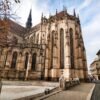
The golden-domed Alexander Nevsky Cathedral is the city’s defining landmark and one of the largest Eastern Orthodox cathedrals anywhere. The nave itself is free to enter; only the crypt museum charges a small fee, around €5. A short walk away, the Serdica Ruins sit directly beneath and around Serdika metro station, an open-air stretch of 2nd-century Roman streets you can walk through free, any hour of the day. Vitosha Boulevard, the city’s pedestrian spine, runs for nearly three kilometres lined with cafés, shops and a direct view toward Vitosha Mountain, and it costs nothing to wander for an entire afternoon.
Free walking tours run daily from the city centre on a tip basis. Two hours with a good local guide, for whatever you choose to pay at the end, will teach you more about Sofia’s layered history than any guidebook.
Where to Eat
Bulgarian food is criminally underrated, and eating well here is cheap almost by default. Shopska salad, tomato, cucumber, onion and grated sirene cheese, is the unofficial national dish and costs next to nothing at any local restaurant. Banitsa, a flaky pastry filled with egg and cheese, is the go-to breakfast, sold from bakery windows across the city for under a euro. For a full meal, look for a бизнес обяд (business lunch) menu between noon and 3pm. Two or three courses for €6 to €9 is standard, and it is invariably the best value food in the neighbourhood.
Day Trip: Plovdiv
An hour and a half south of Sofia by bus sits Plovdiv, one of the oldest continuously inhabited cities in Europe. Its Roman amphitheatre still sits open to the street in the middle of the old town, not roped off behind a ticket booth, just there, in daily use for concerts and events. The old town itself, cobbled lanes lined with Bulgarian Revival-era houses, rewards a slow afternoon of wandering more than almost anywhere else in the region.

Why Sofia Belongs on Your Radar Before Everyone Else Discovers It
Cities like Prague and Budapest were once exactly where Sofia is now: cheap, underrated, and mostly ignored by mainstream travel content. That window closed for them years ago. Sofia’s window is still open. The infrastructure is solid, the history is real, and the price point is currently unmatched among European capitals.
This is the same principle behind every destination we research at Ytrips: find the places that deliver the most before the crowds and the price hikes arrive, and share exactly what we find. No filler, no recycled top-ten lists, just real numbers and routes.
If Sofia has you rethinking which capitals actually deliver in 2026, our guide to Zagreb, Croatia gets the same treatment next.
👉 Follow @ytrips.eu for the next underrated city before everyone else catches on.
Cost and pricing data sourced from Budget Your Trip and Eurostat travel expenditure indices (2026). All figures are approximate and vary by season and booking window.